Positive Messaging: Climate Edition

Update 4/22/24: The Biden Administration just opened applications for the American Climate Corps. From Sunrise “Four years ago, Sunrise began campaigning for a Climate Corps. We walked hundreds of miles. We protested in the streets in DC and around the country. We built coalitions. Now 20,000 young people will work this summer and fall to care for their communities and tackle the climate crisis through the program. Check out the open positions and share them with every young person you know. CHECK OPENINGS 

The media still hasn’t found a path forward to help protect Democracy. They uplift disinformation, don’t hold radicals accountable and cover only bad news. But you can make a real difference by talking to real people! From Uber drivers to that neighbor or relative, you may have a chance to talk about Biden’s accomplishments or other good news that the media ignores.  Remember, most people do not pay for a newspaper or even watch the news – whatever the reason, they just don’t pay attention. Here are some conversation starters!

Biden and Climate

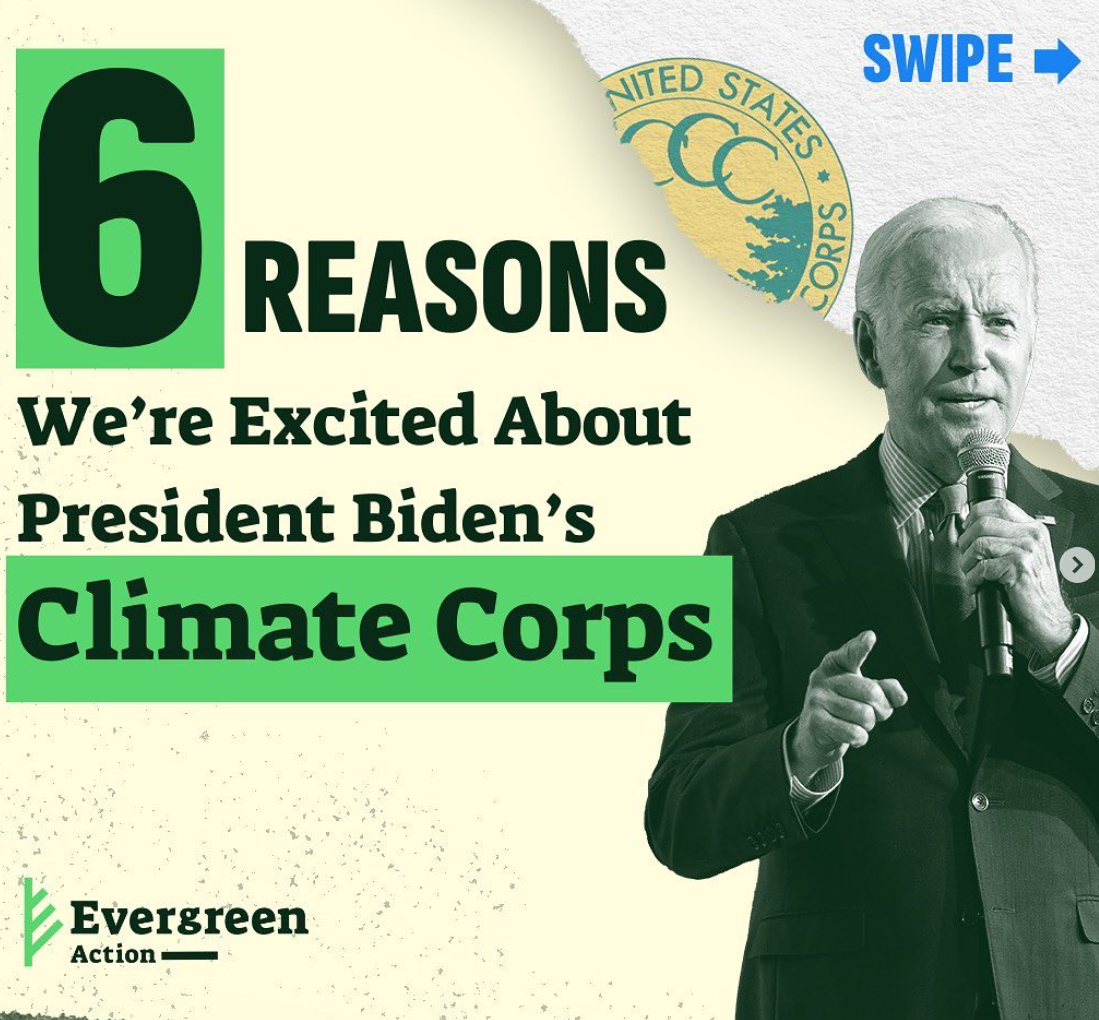
Did you know that in September, Biden used existing funds to establish the American Climate Corps? He patterned it after the New Deal’s Civilian Conservation Corps. Most of the jobs will need no prior experience, and Biden’s plan is to quickly create 20,000 jobs with good wages, benefits and the right to organize.  He will offer education awards similar to the AmeriCorps program.  The jobs will be in clean energy and climate resilience.  So far, there are state and federal programs working together in Arizona, California, Colorado, Maine, Maryland, Michigan, Minnesota, North Carolina, Utah and Washington.  

This won’t be your grandfather’s CCC, though – Biden has centered equity and environmental justice at its core.  That simply means fairness.  It means creating good jobs in communities most affected by pollution, usually disadvantaged areas.  It’s not an accident that industrial pollution is worse in communities already suffering; they don’t always have the resources to fight back.  So, the American Climate Corp will create good jobs, where investment will make a huge difference in the health and well-being of its residents.  I’d sure like to see that program continue and expand under another Biden term!

Conversation Tip:  

This might be a great way to bring generations together!  My grandfather was in the 1930s Civilian Conservation Corps – his (all-white male) unit built roads and bridges in the Colorado mountains.  What did your family do in the 30s?  Was the New Deal meaningful to your family?  It’s almost 100 years since then – can we use it again to lift people out of poverty and give back to the nation at the same time?

More good climate news

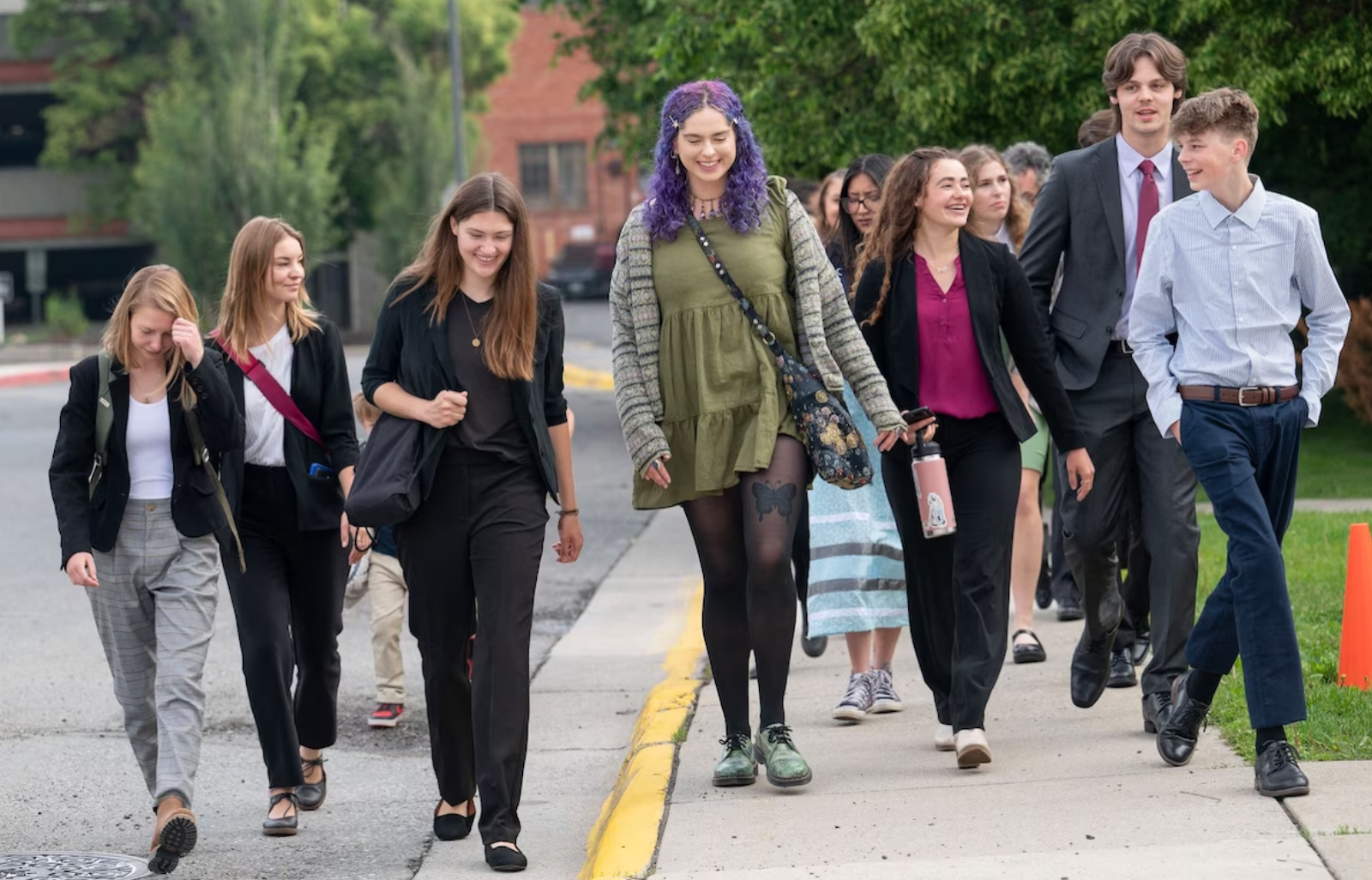
In August, Montana youth won their lawsuit arguing that their state violated their right to a clean environment.  Why is this so important?  The district court was striking down a Republican state law barring Montana from considering climate impacts when permitting energy projects.  Yes, that’s correct – Republicans wrote a law to say you couldn’t even talk about climate issues during zoning and permitting processes.  

Montana’s constitution is unique in that it includes the right to a “clean and healthful environment,” added in 1972.   The Court affirmed that climate is included in this right. 

Currently, the Republican government of Montana has promoted fossil fuels, especially coal, which is significantly dirtier than natural gas.  The plaintiffs, from age 5 to 22, testified that “climate change has jeopardized their recreation, traditions, mental health and physical health.”  The Indigenous plaintiffs testified that climate change threatens their land and culture.

I don’t think it’s a coincidence that 2022 was the 50th anniversary of Montana citizen’s 1972 state constitutional convention that changed their state from a “corporate colony to an era of grassroots democracy.”  It’s an inspiring story of people rising up to do what is right for the land and themselves.  I bet learning about this history helped inspire the current lawsuit!

Conversation Tip:

Ask someone to share their experience in nature.  What makes it important to protect and preserve our natural spaces?  Who really benefits when Republicans allow corporations to industrialize?  Who is hurt?  Climate Change is such a broad term – what does it mean for our wild spaces? 

Positive Messaging: Gun Safety Edition

The media still hasn’t found a path forward to help protect Democracy. They uplift disinformation, don’t hold radicals accountable and cover only bad news. But you can make a real difference by talking to real people! From Uber drivers to that neighbor or relative, you may have a chance to talk about Biden’s accomplishments or other good news that the media ignores.  Remember, most people do not pay for a newspaper or even watch the news – whatever the reason, they just don’t pay attention. Here are some conversation starters!

Biden and Gun Safety

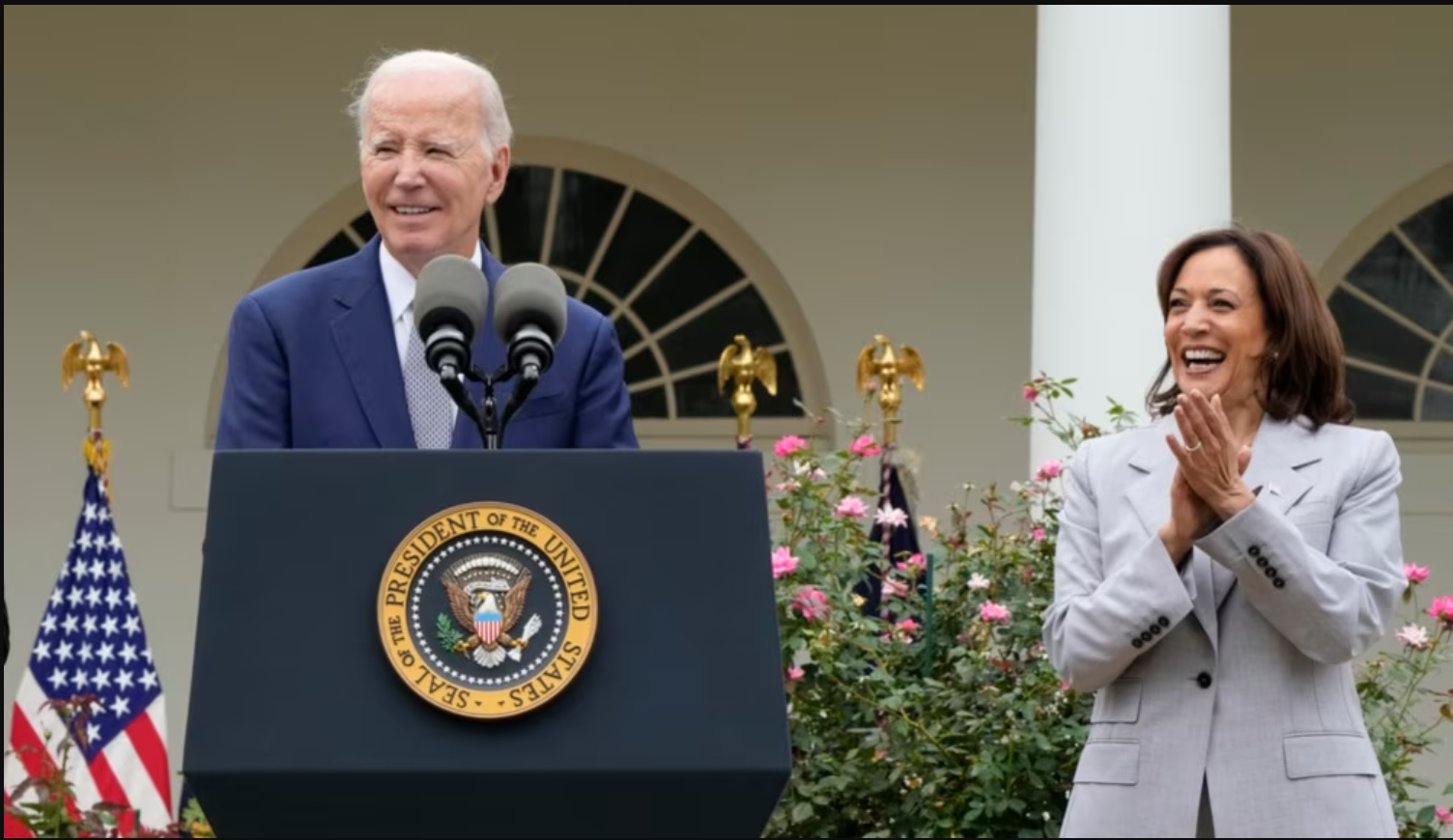
Frustrated with the lack of action from Republicans in Congress, President Biden signed an executive order to create the White House Office of Gun Violence Prevention.  Vice President Harris will oversee the Office, which was created this September.  The leadership team also includes Stephanie Feldman, Greg Jackson, and Rob Wilcox, activists who have been working on gun safety policy for a decade.  This new WH Office is an important way to devote resources and expertise to implementing executive actions, rules and regulations through the DOJ .  They will also provide a critical function often overlooked by activists-making sure the existing laws are fully put into practice. 

Biden was able to pass the Bipartisan Safer Communities Act in June, 2022, the only significant gun safety legislation in 30 years.  This legislation keeps guns out of the hands of minors, improves mental health services in schools, and invests in community violence interventions.  It makes it easier for communities to pass “Red Flag” laws by providing coordination and funding.   It also gives the DOJ more authority to prosecute firearm traffickers.

Biden’s Executive Orders include holding rogue gun dealers accountable, keeping repeat shooters and dangerous weapons off our streets and providing resources to address the root causes of gun violence.

Biden needs Congress to pass legislation to go further.  He has called on Congress to ban assault weapons and high-capacity magazines; require safe storage of firearms; require background checks for all gun sales; and eliminate gun manufacturers’ immunity from liability.  Republicans and the NRA categorically refuse any gun regulation.  In order for legislation of this magnitude to pass, Democrats must have full control of the House and Senate.  

Did the Assault Weapon Ban from 1994 to 2005 prevent gun violence?

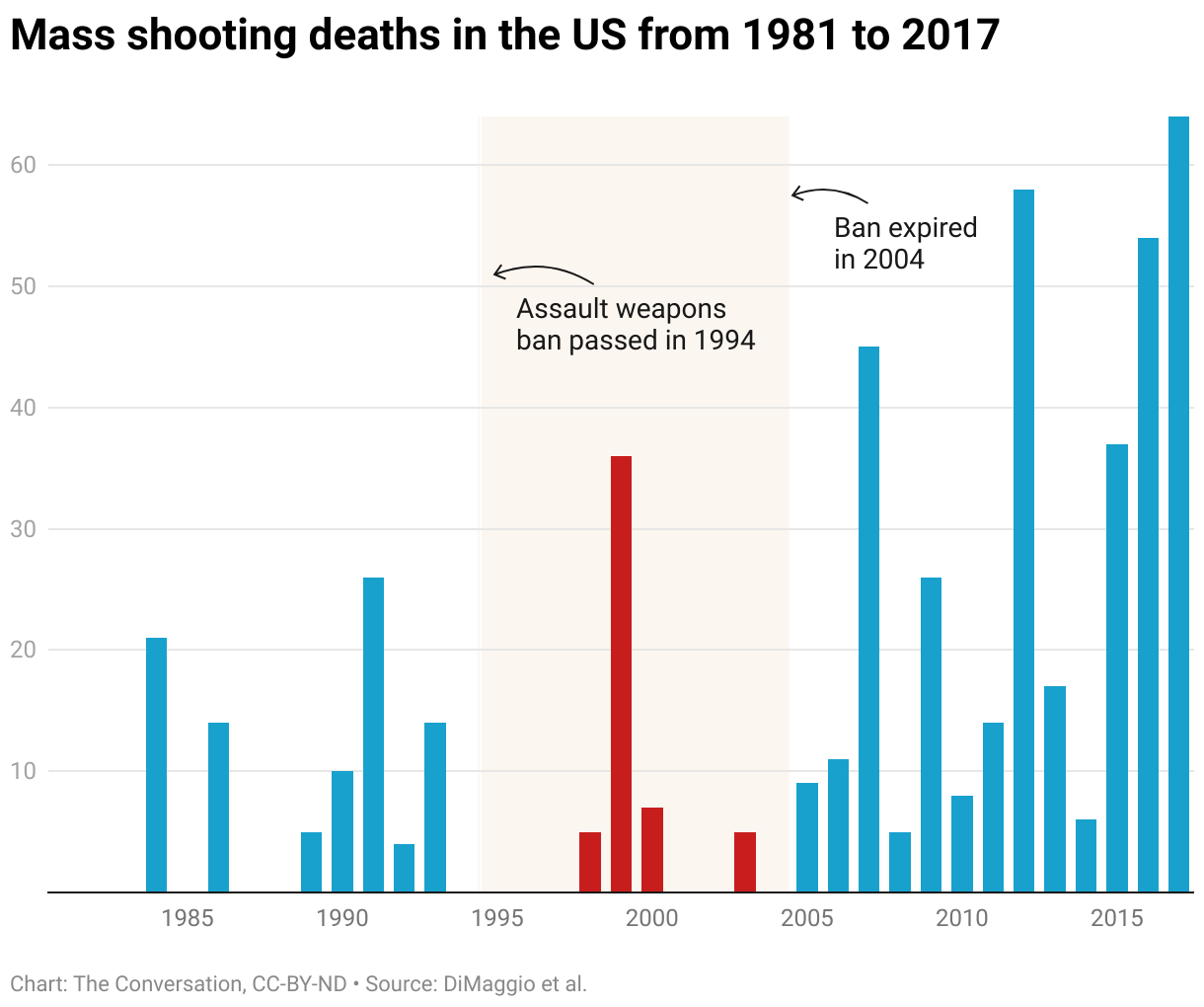
The recent gun safety legislation has renewed interest in gun violence data collected before, during and after the Federal assault weapon ban from 1994 to 2004.  The data gives rise to several conclusions:  

  • Even though the ban was limited to new sales, gun deaths fell during the ban.
  • After the ban expired in 2004, there was an immediate and steep rise in gun deaths.
  • The calculated risk of a person in the U.S. dying in a mass shooting was 70% lower during the period in which the assault weapons ban was active. 
Do “Red Flag” Laws prevent gun violence?

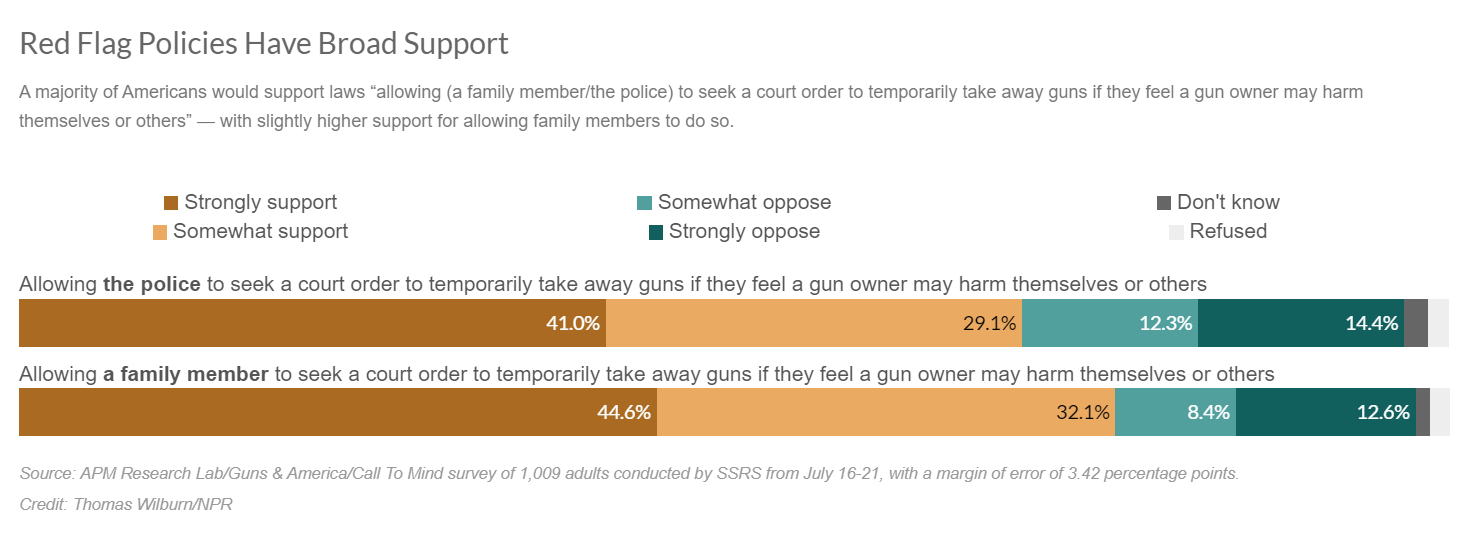
Extreme Risk Protection Orders (ERPO), are sometimes called “Red Flag” laws.  Moms Demand Action encourages using the actual name of ERPO, or Extreme Risk Protection Orders to combat the NRA propaganda around the name “Red Flag.”  There is broad public support for these laws.  16 states currently have varying versions, but basically they allow family or law enforcement to petition a court to at least temporarily remove guns from a dangerous person.  They are especially important in suicide prevention. There is not a Federal ERPO provision.

As of this writing, the latest gun massacre was in the state of Maine, which has no ERPO laws, or background checks.  The Maine shooter was known to the police for threatening acts of violence, but they had no mechanism to remove his guns.  

Even when ERPO laws exist, Sheriffs and other law enforcement sometimes refuse to enforce them, calling themselves “2nd Amendment Sanctuaries.”  Is your Sheriff elected?  Who oversees the law enforcement in your town? 

Touchbase Tuesdays are back!

Tuesdays 1-2 Eastern Time, on zoom

Join Indivisible Acton Area weekly for conversation about local, state and national current events. Let’s get together to update/review/share/plan news and actions people can take to win in 2024. Some of the brainstorming ideas discussed here turn into take action activities for the Indivisible Acton Area.

Why Postcards are More Effective than you Think

A major strength of postcards is that postcards can be highly impactful on a relational level. These powerful effects involve many interrelated people, e.g., family, friends, neighbors, and acquaintances.

The first example of postcarding’s relational capabilities is that the effects of a single postcard can spread like a pebble tossed into a pool. An anecdote from my own experience: a close friend of mine, a former teacher who lives in NY, was voting in a race for a town school board. She had paid only marginal attention to the race and, almost by default, she planned to vote for the candidate recommended by the local board. 

Barbara Head, TP2B Editor

My friend’s daughter came home for a visit one afternoon, saying that she had received a postcard introducing a different school board candidate. The postcard caught her eye, and she shared that this new candidate sounded really interesting. My friend was intrigued, so their two families spent a week researching the candidate introduced by the postcard. Finally, all five family members decided to vote for the new candidate rather than the one supported by the school board. Five votes from one postcard! And who knows how many other people were convinced by my friend and her family.

While the above example features a local race, the ultimate effects on voting behavior may spread beyond local communities and can influence state or national races as well as local. 

“Grassroots volunteers are essential to activist organizations and their campaigns. “

The second example of the relational importance of postcards is the generation of activated volunteers – namely YOU! Grassroots volunteers are essential to activist organizations and their campaigns. Postcards generate enthusiasm among those who write them, and this enthusiasm spreads like infectious laughter. One result is new recruitment. For example, from the postcard group that I manage, several members have been inspired to form new groups of their own, increasing our ranks of activated volunteers.

One of these new group leaders, a former postcarder and friend of mine, moved to a senior community. There she found residents hungry to participate in the election process, and they were eager to write postcards. Postcarding fever rapidly spread throughout the community, as it was meaningful and not restricted by age or disability.  Postcard writing parties took place in the community’s activity room, where residents wrote postcards together. As my friend described it, the 80-year olds wrote on the postcards while the 90-year olds put on stamps and address labels! 

So how does this recruitment of new activists through postcarding directly benefit the ultimate goals of winning elections? It’s simple – activated volunteers VOTE and DONATE.

And they have friends, family, and acquaintances who are encouraged to do the same, causing a ripple effect that will definitely affect elections. 

The point here is, don’t be disheartened by research studies that find relatively small levels of effectiveness through postcarding. (Read more) Remember that even a small contribution can have an outsized effect in small or close elections! And the two examples above show that postcards can gain even more impact through relational effects.

So postcarding really works! Go for it – participate fully in the process, let your enthusiasm spread, and watch us keep winning!

Strategy for Saving Democracy

David Pepper’s Saving Democracy: A User’s Manual for Every American

David Pepper, former Democratic Party Chairman of Ohio, has followed his exposé of the Republican state legislature strategy in Laboratories of Autocracy: A Wake-Up Call from Behind the Lines with his new book:   Saving Democracy: A User’s Manual for Every American.  The new book answers the question most asked after the first book – yes, but how do we fix it?

The Two Battle Problem

In his second book,  David Pepper first recaps his argument that Democrats are losing because we are not engaging in the same battle as MAGA.  Typically Democrats have had more interest in Federal elections and policies and using them to enact policies to reflect American preferences.  This leads to an overemphasis on a few “swing states” and Federal candidates, with many voters only participating in a presidential election cycle.    This preference is so strong that Democrats even have to work hard to turn out our base for Federal midterm elections!  The Republican strategy has been to exploit weaknesses in our democracy so that they can enact their unpopular policies state by state.  They have long focused on taking over state legislatures through subversion of the census, extreme gerrymandering, and radical  judicial appointments.  Once in power, Republican legislators  enact voter suppression laws and are difficult to dislodge. Since most legislation is passed in the U.S. at the state level, their efforts decisively affect legislation on key issues such as guns, voting, abortion, the environment, etc.

The result of the two battle problem?  Past Democrats have ceded victory to Republicans in state legislatures.  State and local contests are not funded or supported by the Democratic party.  Rural districts are abandoned.  There are large numbers of uncontested state house elections, which allow extremist, counter majorian people to get elected and stay in power.

The consequences are dire.  Uncontested seats allow Republicans to hide their policies from debate, which allows private interests to continue to siphon off public monies.  Our democratic system expects there to be an adversarial process- that is the only way we can hold our elected officials accountable.  

Uncontested state house elections lead to extreme policies tested and won at the state level, which ultimately affects us at the national level.  Texas’ abortion ban which included a private bounty encouraging Texans to sue doctors was written by a Republican State Senator who ran unopposed in 2022—despite the fact that the ban is deeply unpopular. According to polls, only 11% of Texans support a total abortion ban.  The Ohio six-week no-exceptions abortion ban that forced the ten-year-old Ohio girl to seek an abortion in Indiana was introduced by a Republican who ran unopposed in 2022—despite the fact that less than 10% of Ohioans support a ban with no exceptions.  The author of the Mississippi abortion ban that ultimately led to the Dobbs decision was written by a Republican who ran unopposed in 2019, which was the year after the law was adopted. 

The Solution:  Fight both battles!

David Pepper points out that we could devote just 15% of the money donated to aspirational federal races (ex. Amy McGrath in 2020 raised 100 million dollars and lost by 10%) to contest state races.  There would be a meaningful impact, even if many races are not won in the current round.  Indeed much of what needs to be done can be likened to “sweat equity” where money is leveraged to a bigger impact by doing the work.  We need to build voting infrastructure, and recruit and support candidates – ideally no one should run unopposed.  

Scaling Up:  Dedicating your Entire Footprint to Democracy

The rest of his book is dedicated to laying out a blueprint for how the average citizen can leverage their own network or “footprint” to fight for democracy.  There are so many good ideas there that we will explore them individually.  This month we are discussing  Practicing David Pepper’s Saving Democracy Conversations.

What you can do right now

There are good opportunities to get involved in important state races right now. Abortion, education and voting rights are on the line.  Turn Purple 2 Blue will be posting actions as they become available.  We’re watching two states right now:

1. A special election in New Hampshire:  A democratic win here would remove republican control from the NH state house.  Read more here.

2. Virginia Elections:  The entire state house is up for reelection, and there have been some redistricting changes.  We need to hold the Democrat’s slim majority in the State Senate, but there is an opportunity to take back the House of Delegates. Find Virginia Actions here.

Can we undo decades of ceding the battle of the State Legislatures?  To paraphrase a Chinese proverb:  The best time to plant a tree is 20 years ago.  The second best time is now.  So let’s get started!

Why Should We Care about Rural Voters?

The progressive activist organization Indivisible answers that question for us. Indivisible has one of the largest rural footprints in the country, with rural groups and members in all 50 states. Below, they explain why we Democrats need to seek out and encourage rural voters to join our coalition in order to win elections and turn our country around.

Rural organizing is severely underinvested in, due in large part to the way rural areas are stereotyped as homogenous, MAGA strongholds. The idea that rural areas are unwinnable and marginal is shared by some campaigns and Democratic Party leaders, resulting in critical resources being pulled away from progressive rural organizing.

That’s a huge mistake. Rural areas are more diverse politically and racially than some might expect. People of color make up a fifth of the rural population and an even larger percentage in the Deep South and in the West. And contrary to stereotype, Democratic candidates routinely win over 30% of the vote in many rural areas. In an era of close elections, these rural votes are just as important as votes in urban and suburban areas.

The impact of grassroots efforts in rural areas can be seen in past elections:

  •  In Georgia, Black rural voters mobilized to help re-elect Sen. Raphael Warnock. 
  • In Arizona, progressive voters in the tribal nations as well as those in rural counties turned out to help defeat Blake Masters and Kari Lake.
  • In Alaska, Indivisible rural group Stand Up Alaska played a crucial role in Rep. Mary Peltola’s upset wins in last year’s midterms. 

And it’s more than just elections…

Rural communities also are on the frontlines of some of the biggest battles we face as a country:

  • As fossil fuel companies threaten our climate, air, and water, rural Indivisible groups have fought against oil pipeline projects across the country. 
  • They’re challenging the power of corporate monopolies by fighting for the right to repair
  • They oppose book bans in schools and work to keep local libraries open as critical community hubs. 
  • And folks in these communities are often the most endangered by the spate of anti-LGBTQ+, anti-choice laws being passed across the country and the stigma that comes with them. 

There is growing grassroots energy in rural communities across the country, and you can be part of it! Your donations and hard work are helping rural groups fuel that energy to drive lasting change. Visit Indivisible’s rural network, Indivisible Rural Caucus, to get involved in this critically important area. In addition, check out Force Multiplier’s Rural Democracy Initiative’s Rural Victory Fund, which supports key grassroots groups from rural areas in eight states. And keep your eyes out for grassroots actions coming from rural organizations posted on Turn Purple 2 Blue!


On Sept. 12th, Force Multiplier supports groups doing the critical work of organizing rural voters through the Rural Democracy Initiative’s Rural Victory Fund. Please join them by registering and donating. Why? It’s easy to assume that rural voters are MAGA supporters. The fact is that in 2020, Biden received 30-40% of the rural vote in key battleground states – and those votes helped Dems win critical Congressional seats and the Presidential election. That said, the margin of victory in seven of those states was less than 2%. To hold the Senate and White House in 2024, we need to protect and expand the rural vote.


Rural Arizona Action (RAZA) seeks to create more equitable and just systems through advocacy, accountability and leadership training in rural Arizona communities. RAZA was founded as a response to the lack of resources and year-round civic engagement opportunities available in rural Arizona. RAZA and Rural Arizona Engage, their affiliated 501(c)3 organization, educate, advocate and coordinate in rural communities to build communities of educated, empowered and engaged voters. RAZA develops long-term organizing capacity and creates professional development opportunities for rural organizers.

We Need Wins in Virginia this November

In Virginia, our mission is to reclaim a Democratic majority in the House of Delegates while simultaneously bolstering our presence in the Senate. Virginia supported Joe Biden in the 2020 elections, with his winning percentage standing at 54.11%. We faced challenges as Democrats took narrow losses in both 2021 and 2022. However, the tide turned in 2023, as Democrats won victories in special elections.

The Virginia House of Delegates currently seats 48 Democrats and 52 Republicans. With the entire slate of 100 seats up for contention this year, we aim to flip three seats to gain Democratic control. Numerous open seats and retirements fuel our optimism to uphold and potentially expand our majority.

In the Virginia State Senate, where Democrats currently command 22 seats in contrast to Republicans’ 18, the critical threshold to maintain control is a maximum loss of one seat. Once again, the revamped electoral maps could help us retain our Democratic majority.

Our overarching objective is to prevent a GOP trifecta by turning the tables in the House and fortifying our position in the Senate. This strategy aims to act as a formidable counterbalance against Republican Governor Younkin’s extreme agenda.

Your Efforts Worked- Victory in Ohio!!!

Last night, Ohio voters soundly rejected Issue 1. This mean-spirited Republican initiative would have toughened the rules for amending the state constitution, making constitutional amendments more difficult to pass. The Republicans’ immediate goal was to defeat a proposition on the docket for this November, which would enshrine abortion rights into the Ohio constitution. Instead, the Republican effort to stack the deck was an embarrassing failure. 

The win in Ohio was, as described by one commentator last night, was a shellacking. With more than 1.2 million votes counted, 60% of Ohioans had voted no, compared with 40% who voted yes, according to the Ohio Secretary of State’s office. That margin was enough for the Associated Press and others to call the race.

The Ohio victory joins that of Kansas and Wisconsin in addition to the 2022 midterms in proving that Democratic voters will defend their interests in preserving basic freedoms, including reproductive, civil, and voting rights. The victories were won in both red and purple states, showing the power of Democratic ideals and grassroots power over autocracy. 

So what are the Democrats’ take-homes? 

  • First, as political commentator Robert Hubbell put in his substack this morning, turnout matters!! The vote on Issue 1 was deliberately chosen by Republicans for August, a traditionally low turnout period, to cynically try to sneak the initiative through without the Democrats noticing. It failed – we noticed and responded with a high turnout.
  • Second, grassroots power matters!! Grassroots volunteers contribute both muscle and funding. Every postcard you write, every text or call or donation you make, helps defeat Republican efforts to strip us of our democracy. With the Swing Blue Alliance Vote No in August campaign, which many of you participated in, 1,230 postcard writers sent election info to 40,000 Democratic voters. This translates into only 1-2 packets per writer, which is easily achievable. 

So victory is sweet and motivates us to fight back fiercely to protect our constitutional rights. YOU helped to defeat this dangerous proposal. But we can’t rest on our laurels, we must keep up the pressure over the next year. We can do it through grassroots power!

Your Work has Impact! 

Last week, I was explaining to a family member that I was going to Indigenous Lobby Day.  They weren’t impressed, and it got me thinking about why it is important to support the members of our broad Democratic coalition.

This is the hard work in between glitzy yes/no elections. A common and recurring complaint about the Democratic party is that we expect everyone to show up at election time.  But where are we in between?

Are you LGTBQ?  Indigenous?  AAPI?  Black?  Latino? Undocumented? Unhoused?  Desperate for Childcare?  Sinking under Student Loans? Worried about your Bodily Autonomy?  Unhealthy and underinsured? Living Paycheck to Paycheck? Concerned about Nukes?  Thinking daily about Climate Change and how it affects your family?

It doesn’t matter-we’re all in this together!  YOU NEED TO SHOW UP NOW.

A broad coalition beat back facism in 2020. Like a garden with many different plants, insects, birds and mammals, coalitions need tending.  Coalitions are based on shared interests but also a lot of compromises.  We have to be there to advocate for each other.

How can your treasure and time nurture our coalition? 

Donate directly to grassroot groups doing the work.  Don’t wait, they need early money now!

Call, Write, and Show Up.  Repeat. 

We have tons of fun meeting up at lobby days, hearings and rallies – but calls and letters are important too.  Try a snail mail letter or postcard for fun!  Ask them to call you back!  

Purple NC:  The Synergy between GenZ and Rural Voters

North Carolina, with its 15 electoral votes, continues to be a key state in Federal elections.  It’s actually the second most rural state (after Texas); all but 20 counties have less than 50% municipal residents.  One in three people live in a rural county.

I highly encourage you to watch this 18 minute interview of Anderson Clayton, age 25, the youngest elected leader in the history of the North Carolina Democratic Party. She is a strong and vocal advocate for rural communities like the one she grew up in, which she believes have often been forgotten by her party.  (While you are there, be sure to “like” the video to help spread the message.)

GenZ has stepped up in a big way in North Carolina.  These young leaders will be important surrogates for President Biden’s reelection campaign.  They are doing the hard work on the ground right now – fine tuning and spreading the Democratic message, registering voters, and electing Democrats up and down the ballot.  County parties are very important in NC and can use our donations now to win very important county and municipal races. This will help develop a deep bench for statewide races in 2024 as well. 

Donate now to help protect abortion, education, healthcare and LGTBQ rights in NC (and lay important groundwork for 2024.)

Another great group in North Carolina is Down Home Carolina.  We have spotlighted this group for two years now because of its goal to build multiracial power in the small towns and rural places in North Carolina. The narrative that progressive policy has no place in the rural South is wrong — that’s why they work to dismantle the narrative and the power structure that doesn’t work for poor and working-class people.

Exit mobile version