Postcards to Michigan Voters

September 9 @ 5:00 pm – 8:00 pm EDT

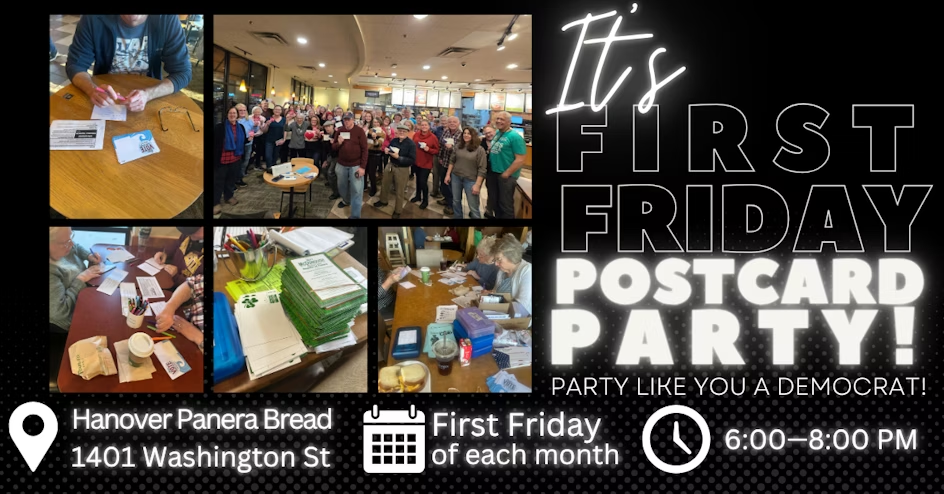
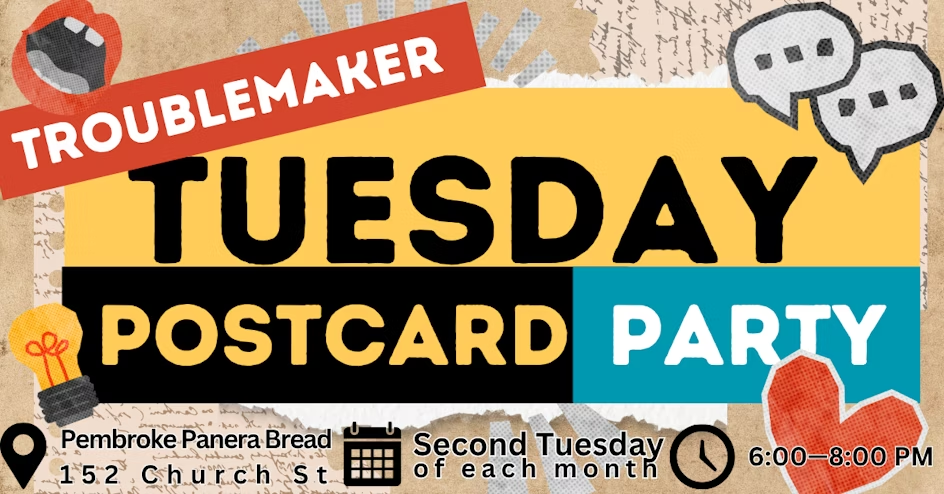
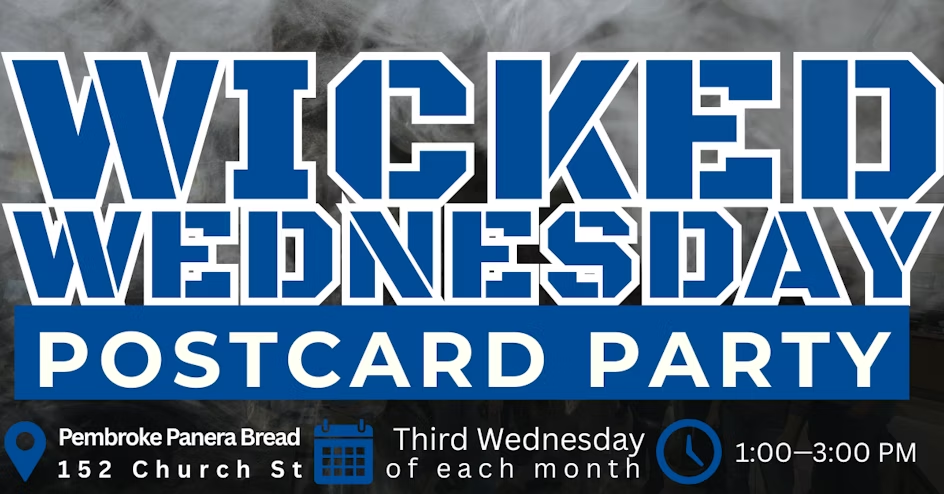
We have more postcards! This time, to write to Michigan voters – and we need your help! Please join us on Wednesday, September 9th any time after 5pm. Hope you can join us! If you are able to donate some postcard stamps, that’d be great, too 🙂

A core principle behind all Indivisible and coalition partner events is a commitment to nonviolent action. We expect all participants to seek to de-escalate any potential confrontation with those who disagree with our values.

Fitchburg, Massachusetts + Google Map

Indivisible LAB Daytime Action Hours

September 8 @ 10:30 am – 12:00 pm EDT

We meet with members, allies, and newcomers to strengthen our community across Indivisible LAB—Lexington, Arlington, Bedford and beyond.

We’ll share updates on actions that address state and national events—including how to protect and help neighbors at risk, learning about and promoting legislation, preparing for upcoming elections, and more.

For protests and standouts, materials for sign making will be on hand.

Please register here to get location details and parking information.

A core principle behind all Indivisible and coalition partner events is a commitment to nonviolent action. We expect all participants to seek to de-escalate any potential confrontation with those who disagree with our values.

Lexington, Massachusetts United States + Google Map

Salem’s Call Second Annual Hot Dog Extravaganza

September 7 @ 12:00 pm – 2:00 pm EDT

Join us across at the Salem Willows for and end of summer Hot Dog Extravaganza!

Bring your friends and sit back for a freshly cooked frank. We provide the weiners, condiments, beverages & desserts, you bring anything else you may desire. A great chance to socialize and enjoy the last day of Labor Day weekend. Hope to see you there!

This is a no cost event. You are welcome to bring any food contributions you like, but that’s definitely not mandatory. All you really need to bring is your smile!

Hope we see you there.

Contact salemscall@yahoo.com with any questions you might have. This a local Indivisible event!

A core principle behind all Indivisible and coalition partner events is a commitment to nonviolent action. We expect all participants to seek to de-escalate any potential confrontation with those who disagree with our values.

165 Fort Ave
Salem, Massachusetts 01970
+ Google Map

🙌 Yes on Question 1: Expanding Public Records Law

PASSED! Public Records Requirements for Legislature and Governor’s Office Initiative – The initiative would require that records the state legislature and the governor’s office hold be public records. As of 2026, documents held by government agencies are considered public records and are subject to legal access requirements, but documents held by the state legislature and the governor’s office are exempt from this requirement.

VOTE YES ON 1 to expand the public records law to cover the Governor and the Legislature. We’re the only state in the country that doesn’t do that already. Let the sunlight in. 

League of Women’s Voters and Progressive Mass both recommend a YES vote.

🙌 YES on Question 2: Collective Bargaining for CPCS Employees

PASSED! Permit Collective Bargaining for Committee for Public Counsel Services Employees Initiative – The initiative would permit employees of the Committee for Public Counsel Services (CPCS) to engage in collective bargaining with their employer. The CPCS workforce includes public defenders, social workers, investigators, and administrative staff.

VOTE YES ON 2 to enable public defenders to collectively bargain. Every worker deserves to have a union, and public defenders, who are often overworked and underpaid, should be no exception. 

Progressive Mass recommends a Yes Vote. League of Women Voters (MA) takes no position.

🙌 NO on Question 3: Top-Two Primary Winners- often called All Party or Jungle primaries

FAILED! Top-Two Primary Elections Initiative – Question 3 would adopt top-two primaries for state offices and require gubernatorial and lieutenant gubernatorial candidates to run as a joint ticket in primaries.  The top-two primary system requires that all political parties put their candidates into the same primary, where they compete against each other. The top two vote getters advance to the general election.

Why Do We Recommend a NO vote?  Question 3 attempts to solve “primary election voter participation and candidate competition.”  It is true that our primaries draw less than 25% participation, and often candidates run unopposed.  However, scarce candidate competition and low voter participation contributes to a moribund statehouse, which is the greater problem. The statehouse is unproductive because we keep reelecting legislators who are bound to moneyed interests, not voters. So will the top-two primary system help us get candidates that will represent people, not lobbyists?  In fact, it could make the problem even worse, as we describe below.

In the top-two primary, candidates need MORE money, not less.  In Massachusetts, the Democrat in the general election typically wins because we are a deep blue state.  But if both Democrats advance from the primary to the general, they both have to run again. To challenge the incumbent, the grassroots-funded candidate would have to win twice, once in the top-two primary and then again in November.  Candidates refusing PAC money would have to raise twice the small dollar donations.  This would be a barrier for most grassroots candidates and favor the incumbent.

Top-two voting causes MORE pressure to leave the race, not less.  The top-two primary system increases pressure on grassroots candidates to leave a race due to fears of vote-splitting, where a large number of candidates split the electorate. In extreme cases, only candidates of one party advance creating the dreaded lockout.  We saw this problem in the 2026 California gubernatorial race.  Their top-two primary included 2 Republicans, with more than 15 Democrats and other left candidates.   Immediately, pressure started on grassroots candidates to drop out of the race to make sure at least one Democrat made it to the general election.   This fear led to the consolidation behind either the billionaire candidate or the candidate backed by PAC money.  While the lockout rate is small, only the fear of the lockout is needed to force candidates out.  

The top-two primary system will not change primary participation. In fact,  Massachusetts already allows the unenrolled voter to vote in the primaries.  In a semi-closed primary system like ours, registered party voters must vote in their own primary, but unenrolled voters may request either a Democratic or Republican ballot.  Voters interested in primaries can already do that.

Top-two voting would give more power to political parties, not less. Currently Massachusetts does not have a system for parties to endorse down-ballot candidates such as state senators and representatives.  The initiative introduces such a system, however it does not describe a process for endorsement. If the concern is that incumbents have too much power,  do we trust either party to create an endorsement process that is fair and transparent? 

Top-two voting would result in fewer grassroots candidates, and more PAC supported Democrats.  The top-two system structurally punishes parties for having too many candidates in the race.   The increased competition makes it harder for an individual candidate to advance and favors those with more money.

The basic problem is how Question 3 defines “competitive elections,” which is their stated goal.  They simply want more people to run for office.  Their goal is not value oriented; they do not care what type of candidates advance to the general election.  It could be 2 Democrats or 2 Republicans.  It could be billionaires or candidates that take corporate PAC money.  

We must ask ourselves, is this the way to solve our unproductive legislature problem?  Or does it simply further entrench party power, the influence of money, and the power of incumbent name recognition?  We urge you to vote NO on Question 3.  

🙌 YES on Question 4: Election Day Registration

PASSED! Permit Same-Day Voter Registration Initiative – The ballot initiative would provide for same-day voter registration.

21 States and Washington, D.C. have already implemented this policy to protect voter’s rights. It’s time for Massachusetts to join them.

VOTE YES ON 4 to enable voters to register to vote or update their registration on Election Day. No eligible voter should be turned away due to a clerical error, and this reform is one of the most proven ways to increase voter turnout. 

Bill Galvin, Secretary of the Commonwealth of Massachusetts, League of Women Voters (MA) and Progressive Mass recommend a YES vote.

🙌 NO on Question 5: Change State Tax Formula

FAILED! Change State Tax Revenue Limit Initiative – The initiative would change the method of calculating the state’s tax revenue limit so that it is equal to the sum of the net amount of state revenue from the year prior and the average growth of wages and salaries in Massachusetts over the past three years. It would also include revenue from the tax on income exceeding $1 million in the state’s definition of tax revenue.

VOTE NO ON 5 to protect our state’s ability to invest in health care, transportation, and public education. Billionaires would get to enrich themselves, while the rest of us suffer from underfunded public services. 

League of Women Voters (MA) and Progressive Mass recommend a NO vote.

Question 6: Create a “Nature for All Fund”

PASSED. Progressive Mass and the League of Women Voters take no position on Question 6.

Steph Solis from Axios Boston reports:

There are no lawsuits or bitter attack ads against Question 6, which would set aside state funding for conservation efforts.

  • But the ballot measure has sparked speculation about state spending and unintended consequences.

Why it matters: Even the least controversial ballot questions can raise questions on Beacon Hill.

Catch up quick: State lawmakers have invested roughly $400 million every year between bonded funding and operational spending for conservation and related projects.

State of play: Question 6 would require lawmakers to set aside at least $65 million a year in a new fund starting in fiscal 2029.

  • The funding wouldn’t raise taxes.
  • Instead, it would pull 50% of existing state tax revenue from sporting goods, RVs and golfing-related sales.

How it works: Question 6 would create a “Nature for All” fund, overseen by a 15-member board, to support land restoration, park improvements and other conservation projects.

  • The state would have to direct half of the earmark to the fund in fiscal 2028 before ramping up to full funding.

What they’re saying: “There is nothing that we pay for clean water and clean air that has a dedicated funding source, and so this invests in those critical resources,” Katie Theoharides, former state secretary of energy and environmental affairs under Gov. Charlie Baker, told Boston.com.

  • Theoharides is now president and CEO of The Trustees, part of the steering committee behind the ballot measure.

Friction point: On its face, environmental advocacy groups support the measure, while the state Republican Party says it would hamstring lawmakers as they decide how to spend taxpayer funds every year.

  • No opposition campaign has formed against Question 6.

Yes, but: Evan Horowitz, executive director at the Tufts University Center for State Policy Analysis, suggests another possible downside — the ballot measure’s floor could inadvertently become the ceiling, as it did with the earmark created for the MBTA in 2000.

  • “I understand the appeal. I just worry that people are going to be disappointed with the result,” Horowitz tells Axios.
  • “It is too easy for the legislature to use this money, not to increase spending, but just to fund the thing it already funds.”

😕YES on Question 7: Single Family Homes

NARROWLY REJECTED. Limit on Required Lot Size for Single-Family Homes Initiative – The initiative would require cities and towns to allow single-family homes on residentially zoned lots that meet minimum standards of at least 5,000 square feet in area, at least 50 feet of frontage on a street or public way, and access to public sewer and water services. In effect, the initiative would preempt local zoning rules that require lots for single-family homes to be larger than 5,000 square feet, which is about 0.12 acres, as long as the other conditions are met.

VOTE YES on 7 to enable more starter homes across the Commonwealth. We have a housing crisis, and large lot size requirements mean fewer homes are able to be built. 

The League of Women Voters (MA) and Progressive Mass recommend a yes vote.